Day 8: Generation of Corrections to the Time Scale
Lecturer: Dr. Andrew, Senior Researcher, Navigation Systems Laboratory
Date: March 2003
1. Introduction: Why Do We Need Time Corrections?
Andrew starts the lecture with a question:
"What do you think will happen if the clocks on satellites and ground stations differ by even a few nanoseconds?"
Some students shrug, but one replies: "There will be errors in determining coordinates?"
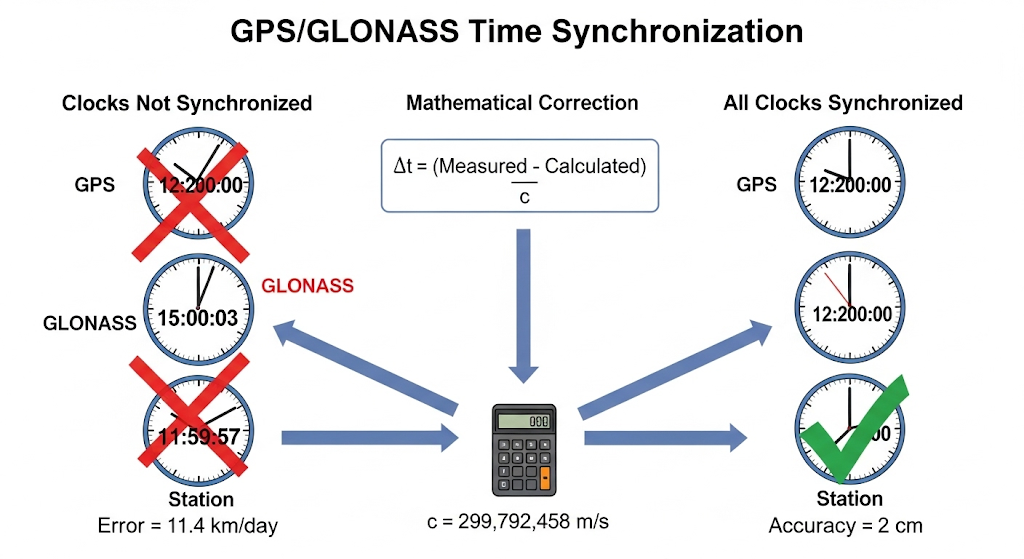
Andrew nods: "Correct! If the time scale of a navigation system deviates, the error in coordinate calculations can reach several meters, and in extreme cases, even kilometers. For high-precision navigation, this is unacceptable. That's why we generate corrections to the time scale to ensure all clocks in the system run in sync."
Today's lecture will cover:
- ✓ Why do different time scales exist?
- ✓ What mathematical methods are used to calculate and compensate for these discrepancies?
- ✓ How are corrections practically generated to align time scales in navigation systems?
2. Time Scales and Their Discrepancies: Why Don't Clocks Sync?
2.1. What Time Scales Are Used in Navigation?
Andrew draws a schematic representation of time scales on the board:
Time Scales of GPS, GLONASS, and UTC (Linear Scale)

Time Scale:   ------------------------------------------------------------------->

GPST: |---------------------|---------------------|---------------------|-------
      |                     |                     |                     |
      1980.01.06          1990                  2000                  2020     Present Time
      GPS Time (GPST)

GLONASST:     |---------------------|---------------------|---------------------|-------
              |                     |                     |                     |
              Linked to UTC       1990                  2000                  2020     Present Time
              GLONASS Time (GLONASST)

UTC:        |---------------------|---------------------|---------------------|-------
            |                     |                     |                     |
            Universal Time      1990                  2000                  2020     Present Time
            UTC (Coordinated Universal Time)
Why are these scales different?
- ✓ Different atomic clock references
- ✓ Signal transmission delays
- ✓ Relativity effects (General Relativity)
Solution: Apply corrections to align time scales.
3. How Are Time Scale Corrections Generated?
3.1. Mathematical Model for Time Corrections
Andrew explains the mathematical model behind time corrections:
The equation for time corrections is given as:
Explanation of terms:
- \(S^{[10]}\) – Measured time signal parameters
- \(R\) – Calculated satellite distances
- \(A\) – Correction coefficient matrix
- \(\Delta \tau_1, \ldots, \Delta \tau_L\) – Time scale differences
- \(K_{\text{GLONASS}}\) – Factor accounting for GLONASS-GPS difference
- \(\Delta \tau_{\text{GLONASS}}\) – GLONASS system time offset
3.2. Solving the Equation
To find time corrections \(\Delta \tau\), we solve the system:
Key components:
- \(c\) – Speed of light (299,792,458 m/s)
- \(V^{-1}\) – Inverse covariance matrix
- \(W\) – Weight matrix that adjusts for data quality
3.3. How Is Accuracy Verified?
If any diagonal element of \(V^{-1}\) exceeds \(10^8\), that parameter is considered unreliable and remains unchanged.
4. Practical Example
Let's consider a simple case with 2 stations and GPS/GLONASS:
Given:
- Station 1 time offset: \(\Delta \tau_1\) (unknown)
- Station 2 time offset: \(\Delta \tau_2\) (unknown)
- GLONASS system offset: \(\Delta \tau_{\text{GLONASS}}\) (unknown)
- Measured pseudoranges contain timing errors
The system solves for all three unknowns simultaneously, ensuring consistent time across the network.
5. Discussion and Student Questions
After the lecture, students start asking questions:
Michael: "If GPS satellites have atomic clocks, why do we still need to correct them?"
Andrew: "Great question! Even atomic clocks, which are incredibly precise, experience drift over time due to relativistic effects—changes in time caused by speed and gravity, as described by Einstein's theory of relativity. For instance, GPS satellites move at about 14,000 km/h (3.9 km/s), causing their clocks to slow down by around 7 microseconds per day due to special relativity. At the same time, they're 20,200 km above Earth, where gravity is weaker, making the clocks run faster by about 45 microseconds per day due to general relativity. Combined, this results in a net drift of 38 microseconds per day. Since radio signals travel at the speed of light (299,792,458 m/s), that 38 microseconds translates to a position error of about 11.4 km per day! This effect is not a secret or proprietary calculation — it is the most thoroughly documented relativistic correction in civilian engineering, formalized in Neil Ashby's widely cited paper 'Relativity in the Global Positioning System' (Living Reviews in Relativity, 2003), and it was first openly tested in orbit in 1977 aboard the NTS-2 satellite, whose relativistic correction was deliberately left switched off for 20 days as a public scientific experiment confirming Einstein's predictions. Additionally, environmental factors like solar radiation, temperature changes, and magnetic fields in space can cause minor clock shifts. That's why we need to constantly apply corrections to keep GPS accurate."
Anna: "Can we use quantum clocks in satellites to make corrections unnecessary?"
Andrew: "That's a forward-thinking question! Quantum clocks are a cutting-edge technology—unlike the cesium atomic clocks in GPS, which are accurate to about 1 nanosecond per day, quantum clocks use optical transitions in atoms like ytterbium and can be accurate to 1 second over billions of years. They're incredibly promising for improving timekeeping! However, they won't eliminate the need for corrections entirely. The relativistic effects I mentioned—caused by the satellite's speed and Earth's gravity—still apply, no matter how precise the clock is, requiring those 38 microseconds per day adjustments. Plus, quantum clocks aren't yet practical for large-scale deployment in satellites. They require complex setups, like ultra-low temperatures and significant power, which are hard to manage in a satellite's compact environment. But in the future, they could reduce how often we need to sync clocks, making systems even more reliable."
Daniel: "How does NASA handle time correction for Mars missions where there are no GPS satellites?"
Andrew: "Excellent question! For Mars missions, NASA can't rely on GPS because there's no satellite network like Earth's. Instead, they use a combination of techniques. First, spacecraft carry their own ultra-stable atomic clocks, similar to those in GPS, and correct for relativistic effects based on their orbit and Mars' gravity—Mars' weaker gravity (about 38% of Earth's) causes a different time dilation effect, around 0.6 milliseconds per day less than on Earth. Second, NASA uses the Deep Space Network (DSN)—a global array of radio antennas—to send precise time signals from Earth and track the spacecraft's position with two-way ranging. This allows them to calculate time offsets with an accuracy of microseconds. Finally, for surface rovers like Perseverance, they sync with orbiting Mars satellites (e.g., Mars Reconnaissance Orbiter), which provide local navigation data. It's a complex dance, but it works!"
Sophia: "Could future laser clocks in deep space eliminate the need for time corrections?"
Andrew: "That's a fantastic forward-looking question! Laser clocks, such as those being developed by NASA and ESA, use optical lattice techniques to achieve even greater precision than quantum clocks. They rely on stabilized laser frequencies interacting with atomic transitions, achieving accuracies far beyond what is possible with traditional atomic clocks. However, even with their precision, they can't eliminate the need for time corrections. The fundamental reason remains the same—relativistic effects. The motion of a spacecraft and variations in gravitational potential will still cause shifts in time, meaning corrections will always be necessary. That said, laser clocks could significantly improve the stability of deep-space navigation, reducing the need for frequent adjustments."
6. Conclusion: Why Is This Important?
Andrew concludes the lecture:
- 📌 Navigation accuracy depends on precise time correction
- 📌 Generating corrections ensures synchronization between GPS and GLONASS
- 📌 Mathematical methods minimize errors and maintain system integrity
Discussion Questions:
- ✓ Why can't we trust raw GPS time without verification?
- ✓ How does relativity impact clock synchronization?
- ✓ Could laser communication improve timing accuracy?
Andrew smiles: "We'll discuss these topics in more detail in the next lecture. See you then!"