Day 10: Message Formation for Transmission to the CKNPU
Lecturer: Dr. Andrew, Senior Researcher, Navigation Systems Laboratory
Date: March 2003
How to Talk to Satellites so the CKNPU Understands
A hands-on engineer's lecture. No fluff. Only structure, logic, and engineering insight.
Introduction
Good afternoon, colleagues.
Today's topic is not just about data transfer. It is about how to build a dialog between a measurement network and a central node—a dialog that leaves no room for misunderstanding, a dialog where each message is a brick in the edifice of precision navigation.
📡 Context
We operate a Control and Correction Station (CCS) running in real time, built on synchronous measurements. It sees satellites, measures, filters, and forms messages. Everything that happens is formalized thinking turned into a binary structure.
On the other end is the Central Kalman Navigation-Processing Node (CKNPU). Its job is to gather every piece of the mosaic, process it, make decisions, and refresh the navigation picture for everyone.
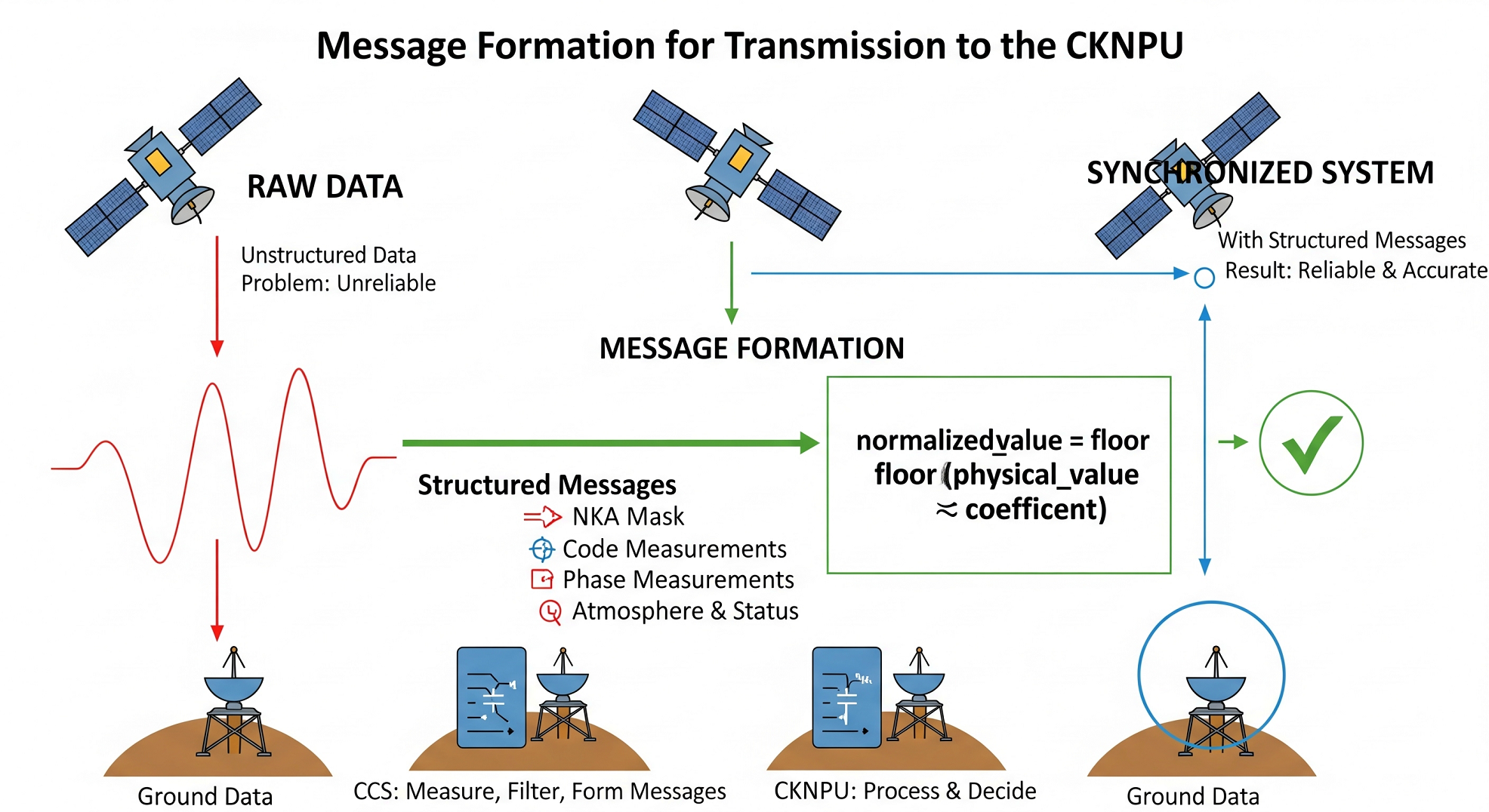
✉️ Message Exchange: Good Engineering Postal Style
We transmit not just bits. We send messages with clear labeling, guaranteed synchronization, and strict processing logic. This is not a stream of consciousness. This is a system. This is... a concentrator.
Messages are letters: each with its envelope, address, and content. The CKNPU is not a mind reader. It understands only when everything is by the book, by the standard, at the right moment—discarding anything not validated by the mask.
📋 Message Types
At our disposal are 64 message types (0–63) — the same numbering scheme used by the public RTCM SC-104 differential-correction format, which likewise allows 64 message types. Yet, in true engineering fashion, we use only those that have proven their necessity.
🛰 Type 1 — NKA Mask
Who is on the line? The message says: "Here is the list of satellites I see and trust." All other messages depend on it. It is like a meeting attendee list: if you're not on the list, you have no voice. The CKNPU relies on this list when processing all subsequent data.
📐 Types 2–5 — Code Measurements
Raw, cleaned, processed, and smoothed data.
- Pseudorange
- Pseudovelocity
- Total carrier phase
- Quality indicators
And all of it is bound to the NKA mask.
🔧 Types 7–10 — Phase Measurements
High-precision data on L1 and L2. Centimeter-level measurements—exactly what you need for landing an aircraft in fog.
🌤 Types 30–32 — Atmosphere, Station Coordinates, Status
Weather, CCS coordinates, and its internal status—everything required for correct data interpretation.
📊 Normalization: How to Fit Giants into a Pocket
Pseudorange can be tens of millions of meters. Sending directly? Impossible. We scale it. Multiply by a coefficient, drop the fraction. Everything becomes integers:
normalized_value = floor(physical_value × coefficient)
Each bit knows its place. Not a single extra byte.
🔄 Synchronization — The Heart of Transmission
The NKA Mask is the main actor. Every message carries a mask issue identifier. It tells the CKNPU: "This data belongs to the satellite set captured in mask #2."
Mismatch — data are ignored. Change the actors but keep the old script, and the play will fall apart.
📦 Transmission Cycle — A Day in the Life of a Station
- Determine visible satellites. The CCS figures out who is visible and usable.
- Send the NKA Mask (Type 1). "Today we're working with GPS-5, GPS-12, and GLONASS-3."
- Transmit measurements (Types 5, 9, etc.). Every second—updates tightly bound to the mask.
- The CKNPU receives. Sorts, filters, applies differential corrections.
🌍 Why It Matters
You are not merely transmitting data. You are building trust between the network and the center. You make sure that:
- millions of passengers land on time;
- the tractor holds its line perfectly straight;
- surveyors distinguish hills from houses with centimeter precision.
And all that—thanks to one well-designed messaging system.
🎓 Finale
Someone might say, "It's just packets of data."
We know: it's an engineering dialog where every bit matters.
And it is you—engineers—who make this dialog possible.
Let's sum up, said Andrew:
The CKNPU system is not just an architecture; it is a sophisticated mathematical engine, implemented at the application level of an information concentrator in a priority-based messaging network. These solutions ran in computing systems that operated for years without a restart, delivering and processing messages in real time. Reliability was achieved not by abstraction, but by engineering discipline, where every message was the result of meticulously crafted logic.
We call this the "Ukrainian algorithm."
(Pause. A few seconds of silence. The audience rises. Applause swells—first reserved, then louder. Not for the oratory, but for the precision, for the engineering truth.)
Until next time. We'll talk about how these messages become coordinates—and how not to lose precision in a digital world.