Internal Principles of the Effort Calculator
How Can We See What We Cannot Touch?
A person cannot take a star in their hands, disassemble it, or directly examine the matter from which it is made.
Yet we know the chemical composition of the Sun and many other stars.
How did this become possible?

The answer came from spectroscopy.
Light arriving from a star can be separated into a spectrum. Characteristic lines appear in that spectrum, allowing conclusions to be drawn about the substances that interacted with the light.
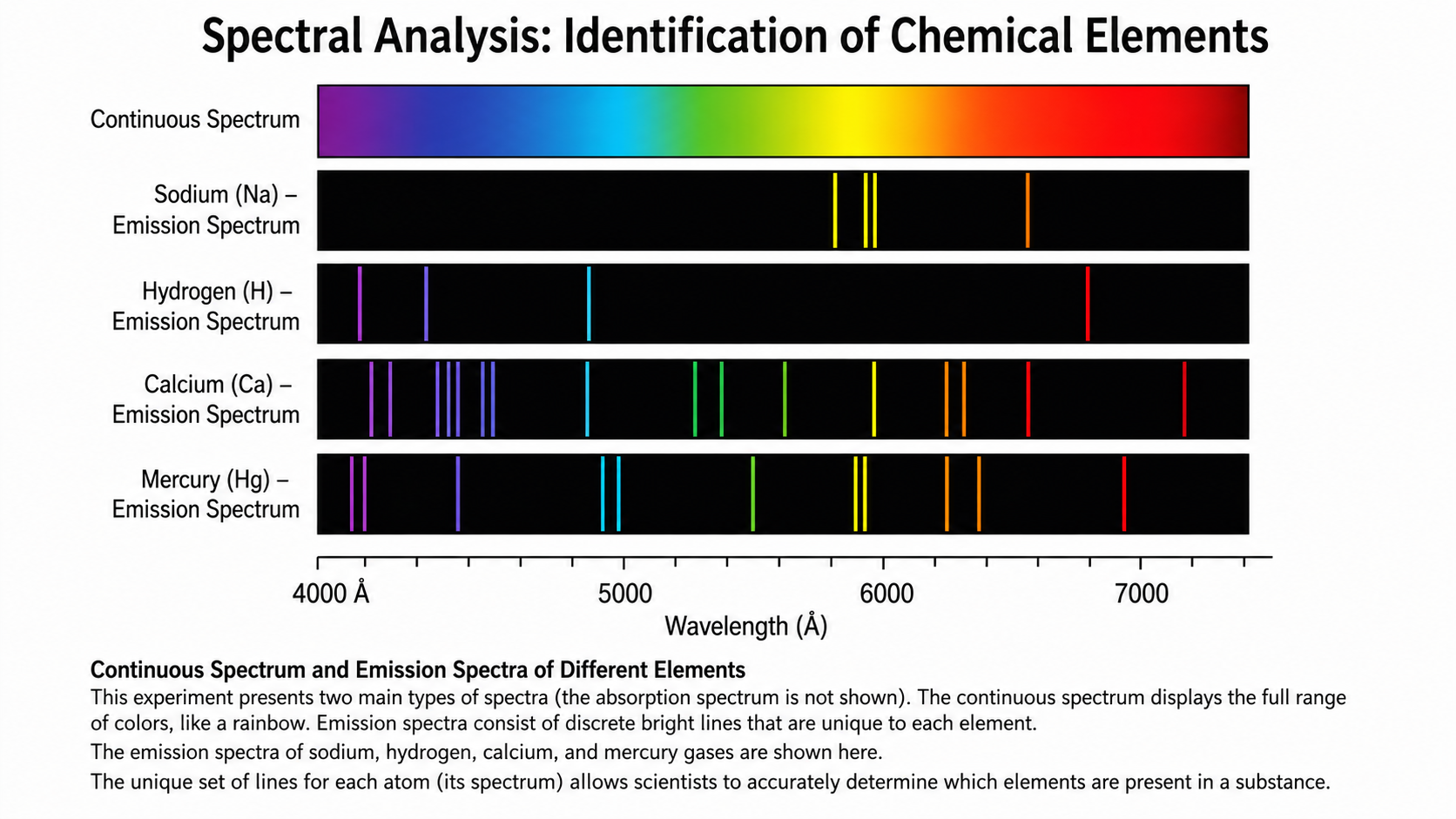
In this way, an object that is physically impossible to reach becomes accessible to investigation through a system of signs it leaves behind.
From Spectral Lines to the Composition of Matter
This path developed gradually.

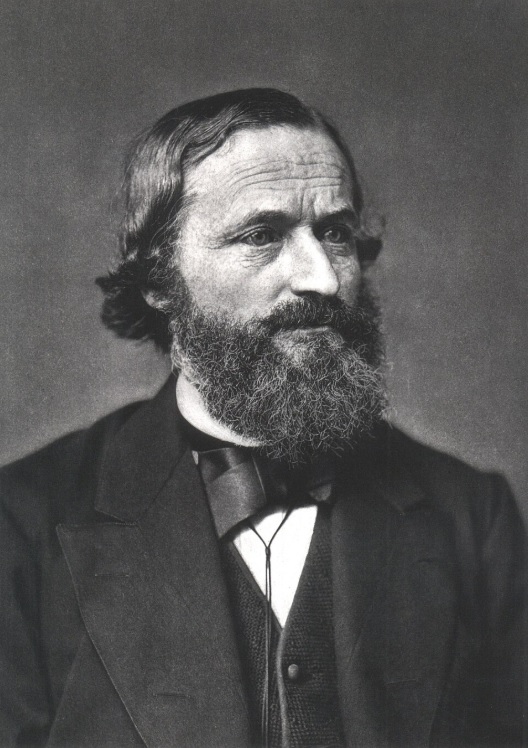

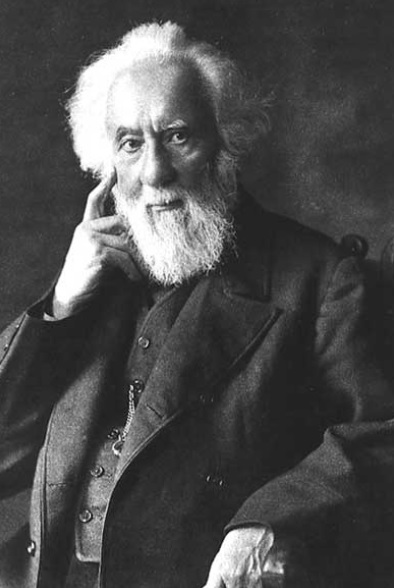
At the beginning of the nineteenth century, Joseph von Fraunhofer studied the dark lines in the solar spectrum in detail. The lines were visible, but their physical meaning still had to be understood.
Later, Gustav Kirchhoff and Robert Bunsen showed that chemical elements have characteristic spectral signatures. A spectrum ceased to be merely a band of colors — it became a source of information about the composition of matter.
William Huggins applied this principle to the study of stars. It became possible to identify elements present in the atmosphere of a distant celestial body by analyzing its light.
There is an important principle in this story: a complex or inaccessible object can be studied through the system of signs it leaves behind.
A System of Elements
During the same period, another way of organizing knowledge about chemical elements was developing.
Knowing the properties of individual elements does not yet mean seeing the system they form.
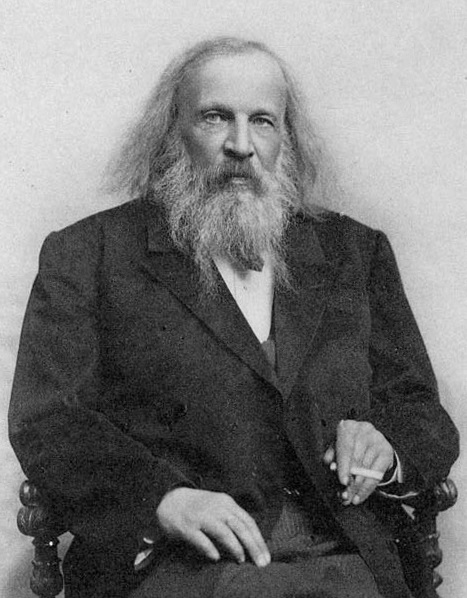
Dmitri Mendeleev organized the chemical elements into the periodic system.
The enormous diversity of matter ceased to look like a collection of arbitrary names. Elements acquired their place within a structure, and patterns emerged in their properties.
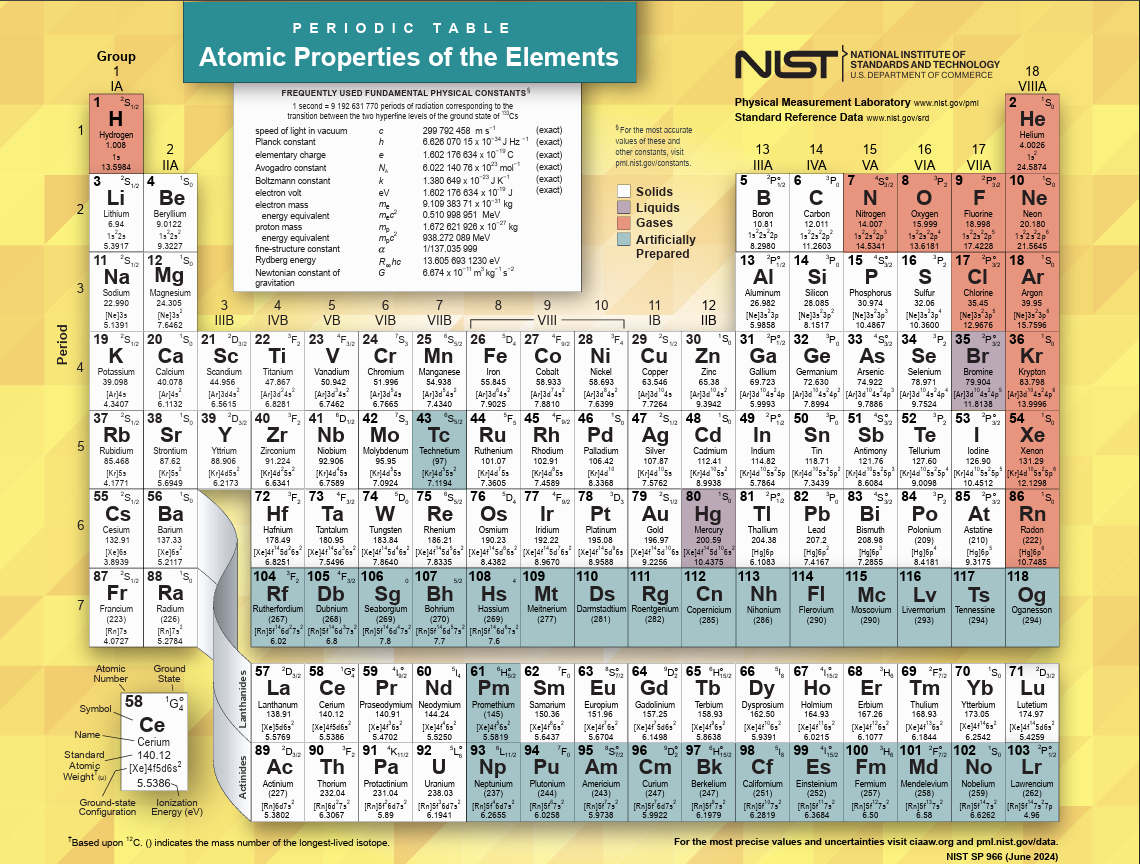
The complex world of matter can be described through a limited set of basic elements.
An Element Is More Than a Name
Let us take one element from the periodic table.
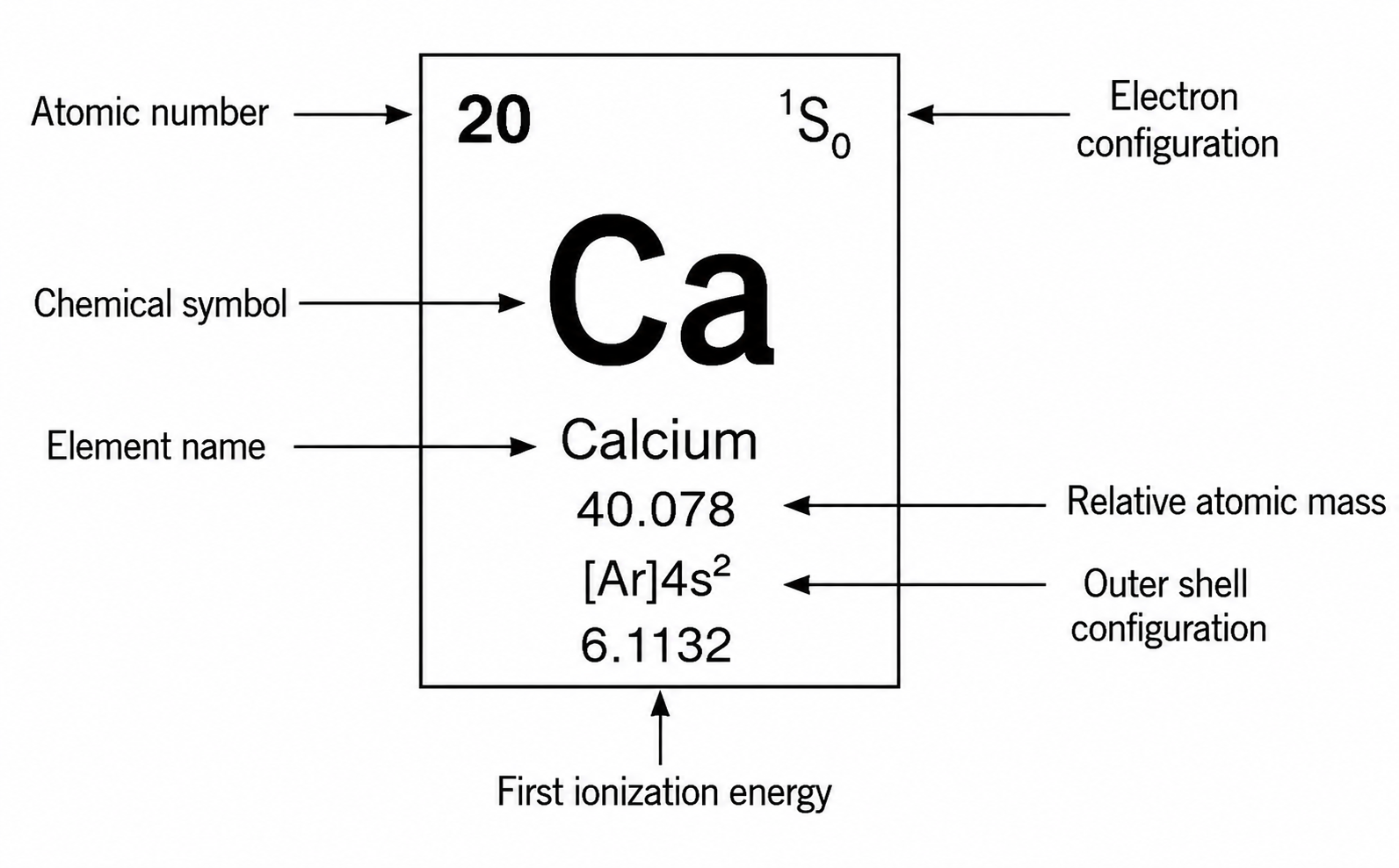
It has a symbol.
It has an atomic number.
It has an atomic mass.
It has a position in the periodic system.
It has a set of physical and chemical properties.
In other words, an element is more than simply the name of an object.
It is an object described by a defined system of characteristics.
This is precisely what allows elements to be distinguished, compared, classified, and used to describe more complex structures.
Digital Polygraph's Own “Periodic System”
Digital Polygraph has its own system of software product elements.
Each such element is described by a set of characteristics.
The user selects from this system the elements that correspond to their product — in the same way that particular chemical elements are selected to form a particular molecule.
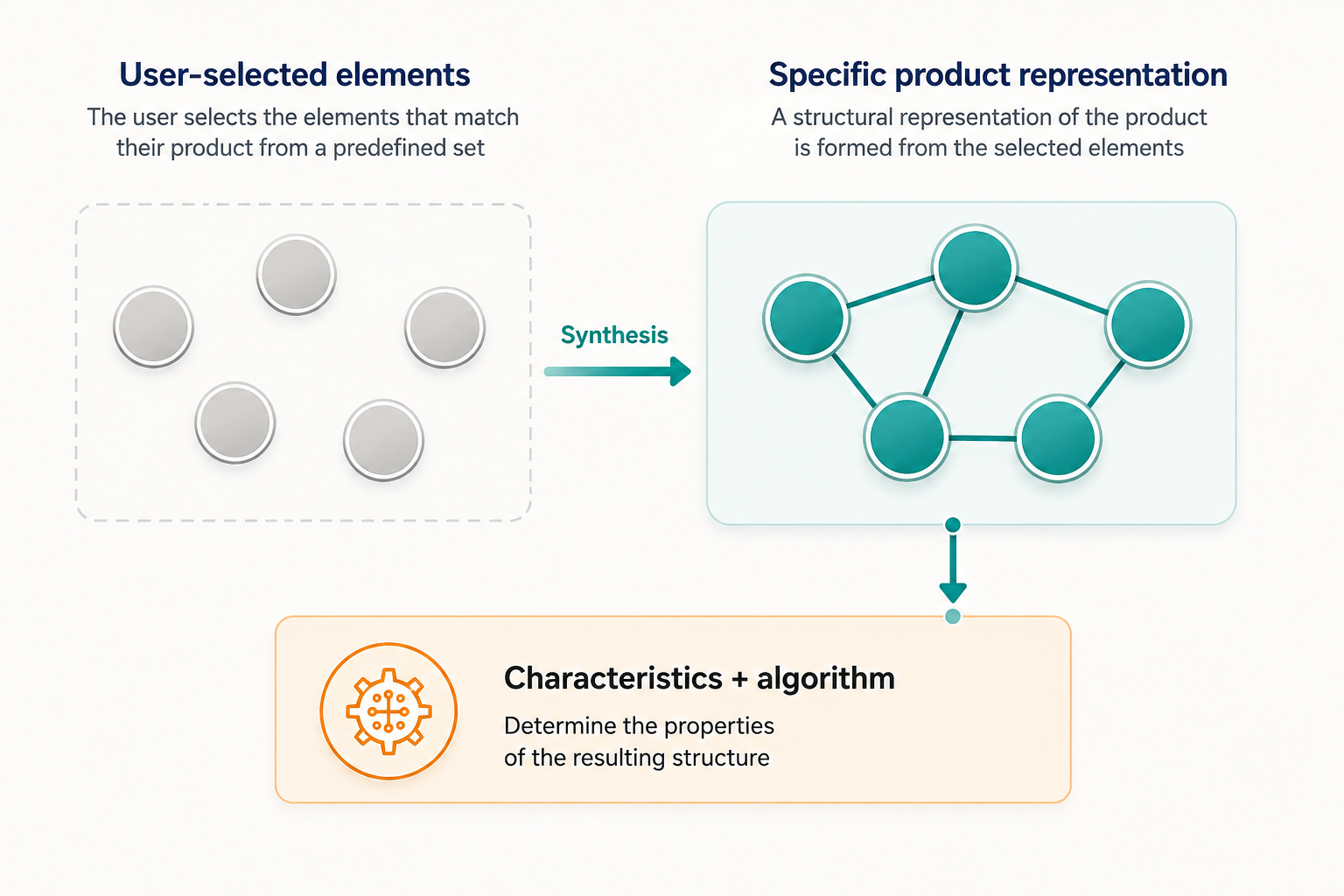
By selecting the required elements, the user creates not an abstract list, but a specific, connected representation of their product — just as atoms form the structure of a molecule rather than simply lying next to one another.
Characteristics refine the properties of the selected elements, while the internal algorithm uses the resulting description for engineering calculation.
The specific composition of this system and the internal mechanics of the calculation are not the subject of this article.
For understanding the principle, one thing is sufficient: a complex software product is first represented as a system of elements and their characteristics.
The purpose of this system is to provide an engineering basis for managing the timing of product development and its entry into a favorable market window. For more about managing delivery timing, see “Timeliness”.
Elements Alone Do Not Make a Substance
Even a complete list of chemical elements does not explain the diversity of the world around us.
Elements combine with one another. They form structures. Let us begin with the simplest.




Two hydrogen atoms and one oxygen atom. Just three atoms — and already a substance with its own properties emerges.
The structure then becomes more complex. Other elements appear, along with more atoms and more connections between them.
Using a relatively small set of chemical elements, nature creates substances with completely different properties.
The reason lies not only in the number of atoms. The elements themselves, their properties, and the way they are combined into a structure all matter.
Complexity is determined not only by the set of elements, but also by the structure they form.
An Analogy, Not a Literal Model
Spectral analysis, the periodic system, and molecules in this article are an analogy.
A software product element is not a chemical element, and a software product is not a molecule.
What they share is a different principle. A complex object becomes more accessible to analysis when we:
identify its components → describe their characteristics → examine the structure they form.
This sequence allows us to move from a general notion of complexity to its structured description.
What Is All This For?
The analogy with spectra, chemical elements, and molecules is not an end in itself. Likewise, calculating effort is not the ultimate goal.
Just as the result in a molecule is determined not by one atom but by the entire structure, in a software product what matters is not an individual element on its own, but the structure as a whole. Its formalized description provides the basis for an engineering calculation.
The practical result of such a calculation is an engineering roadmap for creating the software product.
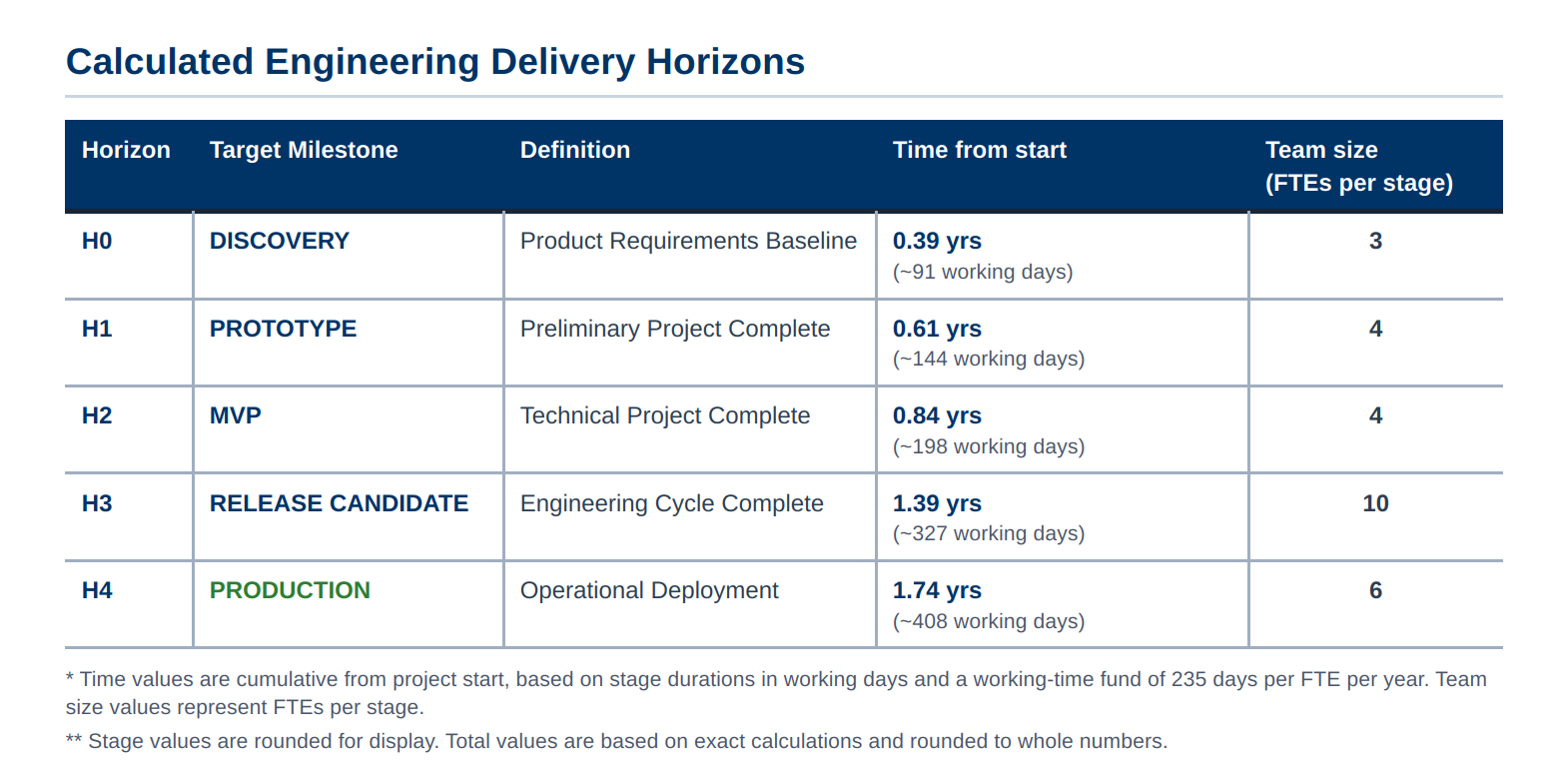
The roadmap shows the successive horizons of product development:
- H0 — Discovery
- H1 — Prototype
- H2 — MVP
- H3 — Release Candidate
- H4 — Production
For each horizon, the target milestone, elapsed time from project start, and required team size are determined.
The purpose of Digital Polygraph is to transform the hidden complexity of a software product into a manageable engineering roadmap: from Discovery to Production.
For how effort is transformed into delivery timing and a team plan, see “Theory: An Engineering Method to Control Software Delivery Dates”.